A text-book on nervous diseases by American authors / edited by Francis X. Dercum.
- Francis Xavier Dercum
- Date:
- 1895
Licence: Public Domain Mark
Credit: A text-book on nervous diseases by American authors / edited by Francis X. Dercum. Source: Wellcome Collection.
Provider: This material has been provided by the Augustus C. Long Health Sciences Library at Columbia University and Columbia University Libraries/Information Services, through the Medical Heritage Library. The original may be consulted at the the Augustus C. Long Health Sciences Library at Columbia University and Columbia University.
282/1096 (page 278)
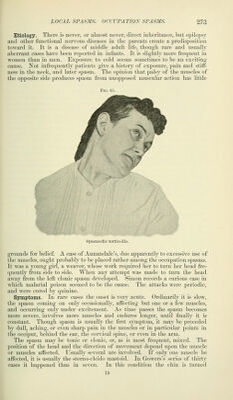
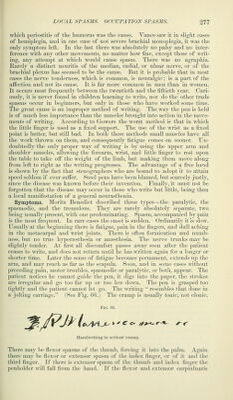
![be aiFected the pen is forced strongly against and digs into the paper. There may be spasm of the pronators and supinators of the forearm, in which event the pen goes hither and thither over the paper, and the markings resemble rather chicken-tracks than writing. Rarely there may be an accompanying spasm of the shoulder muscles. Clonic spasm occurring only on beginning to write and affecting the thumb and index finger occurs infrequently. It should be possible to tell from the handwriting the muscles affected in the disease and whether by s]Dasm or palsy. Tremor almost never occurs alone. It is usually accompanied by tonic spasm. At the beginning it occurs only when Avriting and gives the hand- writing a shaky form. Later it may continue while the patient is at rest or be caused by any movement, and then is apt to invade the left hand also. Ordinarily the tremor is confined to the thumb and first finger. A purely paralytic form of the disease rarely if ever occurs. There is always some spasm, but weakness may predominate. There is fatigue pain in the affected muscles and some difficulty in the voluntary contraction of them. It is rare for coarse movements to be affected, and fine movements, if they differ in character from those made in writing, may be uninfluenced. Some one other complicated movement, may be involved as in a patient of Gowers's who could do anything except shave. There may be a certain amount of weakness in particular muscles as shown by Piore, but usually the grasp of the hand is good. Slight local muscular wasting sometimes occurs. There may be no change in the electrical reactions of either nerves or muscles. In long-standing cases there may be increase or decrease to both the faradic and galvanic currents. Eulenburg found qualitative changes in the nerve trunks. There is apt to be a general condition of neurasthenia or mild hysteria. Various parsesthesise are complained of. Painful points in the course of the nerves of the arm are common, and the nerves may be swollen. Not infre- quently there are tender spots in the spine, especially in the cervical region. There may be a transitory marble pallor of the fingers from vasomotor con- striction. Stammering is an occasional complication. If the patient persists in writing, the condition gradually becomes worse, until finally the act is im- possible. At the beginning it is often possible to write well with a pencil. Patients often use the left hand in writing. In such cases the chances are about equal that it wdll escape. Pathology. There are no known anatomical changes in the disease, but it is highly probable that if we could use the same methods as Hodge used in his experimental study on the effects of fatigue we could find distinct, though fine, lesions in the motor brain cortex, or in it and the cells of the cervical enlargement of the cord. Three theories have been offered to explain the disease. First, that it is local weakness of certain muscles, permitting over- action of their opponents; second, that it is reflex; and, third, that it is central—a want of proper balance in the co-action of the various motor centres concerned in the action of writing. The last is the most satisfactory. Diagnosis of the fully developed disease is easy. The beginning stage may be mistaken for neuritis, a slowly on-coming hemiplegia, or even paralysis agitans, but only if the possibility of the existence of writers' cramp be overlooked. Prognosis in a bad case, or one of long standing, is never very good. It is better in those cases in which outside elements—ill health and worry—have a large causative influence than in those due solely to excessive writing. _ It is better.in cases in which there is a large pain element than in those which are purely motor. Finally, the worst case may recover, while one apparently much less severe may persist.](https://iiif.wellcomecollection.org/image/b21224274_0282.jp2/full/800%2C/0/default.jpg)