Mental work and fatigue and individual differences and their causes / by Edward L. Thorndike.
- Edward Thorndike
- Date:
- 1914
Licence: In copyright
Credit: Mental work and fatigue and individual differences and their causes / by Edward L. Thorndike. Source: Wellcome Collection.
Provider: This material has been provided by The University of Leeds Library. The original may be consulted at The University of Leeds Library.
284/434 (page 266)
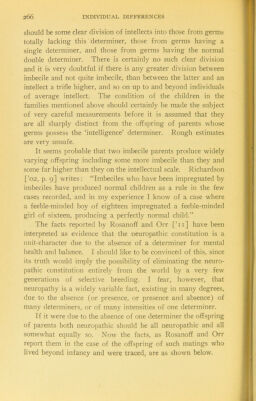
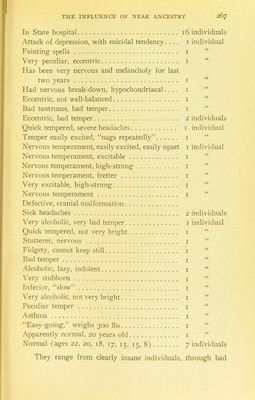
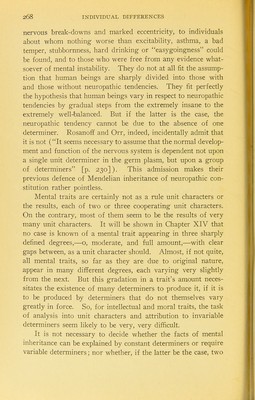
![should be some clear division of intellects into those from germs totally lacking this determiner, those from germs having a single determiner, and those from germs having the normal double determiner. There is certainly no such clear division and it is very doubtful if there is any greater division between imbecile and not quite imbecile, than between the latter and an intellect a trifle higher, and so on up to and beyond individuals of average intellect. The condition of the children in the families mentioned above should certainly be made the subject of very careful measurements before it is assumed that they are all sharply distinct from the offspring of parents whose germs possess the ‘intelligence’ determiner. Rough estimates are very unsafe. It seems probable that two imbecile parents produce widely varying offspring including some more imbecile than they and some far higher than they on the intellectual scale. Richardson [’02, p. 9] writes: “Imbeciles who have been impregnated by imbeciles have produced normal children as a rule in the few cases recorded, and in my experience I know of a case where a feeble-minded boy of eighteen impregnated a feeble-minded girl of sixteen, producing a perfectly normal child.” The facts reported by Rosanoff and Orr [Ti] have been interpreted as evidence that the neuropathic constitution is a unit-character due to the absence of a determiner for mental health and balance. I should like to be convinced of this, since its truth would imply the possibility of eliminating the neuro- pathic constitution entirely from the world by a very few generations of selective breeding. I fear, however, that neuropathy is a widely variable fact, existing in many degrees, due to the absence (or presence, or presence and absence) of many determiners, or of many intensities of one determiner. If it were due to the absence of one determiner the offspring of parents both neuropathic should be all neuropathic and all somewhat equally so. Now the facts, as Rosanoff and Orr report them in the case of the offspring of such matings who lived beyond infancy and were traced, are as shown below.](https://iiif.wellcomecollection.org/image/b21524221_0284.jp2/full/800%2C/0/default.jpg)