Text-book of the embryology of invertebrates / by E. Korschelt, K. Heider.
- Korschelt, E. (Eugen), 1858-1946. Lehrbuch der vergleichenden Entwicklungsgeschichte der wirbellosen Thiere. English
- Date:
- 1895-1900
Licence: In copyright
Credit: Text-book of the embryology of invertebrates / by E. Korschelt, K. Heider. Source: Wellcome Collection.
167/508
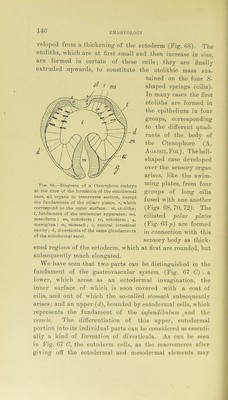
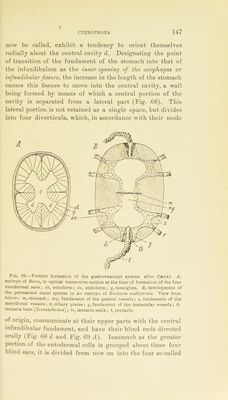
![now be called, exhibit a tendency fco Orient themselves radially about tlie central cavity d. Designating the point of transition of tbe fundament of the stomach into tbat of the infundibulum as tbe inner opening of the cesophagus or infundibular fissure, tbe increase in tbe lengtb of tbe stomach causes this fissure to move into the central cavity, a wall being formed by means of which a central portion of the cavity is separafced from a lateral parfc (Fig. 68). This lateral portion is not retained as a single space, but divides into four diverticula, which, in accordance with their mode Fis. 69.—Further formation of the gastrovascular System after Chon). A, embryo of Beroe, in optical transverse section at the time of formation of the four entodermal sacs; ek, ectoderm; an, entoderm j g, mesoglcea. B, development of the permanent canal System in an embryo of Eucharia multicornis. View from below: m, stomach ; mg, fundament of the gastral vessels; x, fundament of the meridional vessels ; r, ciliary plates ; y, fundament of the tentaoular vessels ; Ib tentacle basQ [Tentakelboden]; ts, tentacle stalk; t, tcntacle. of origin, communicate at their upper parfcs with the central infundibular fundament, and have their blind ends direcfced orally (Fig. 68 d and Fig. 69 A). Inasmuch as the greafcer portion of the entodermal cells is grouped about these four blind sacs, ifc is divided from now on into the four so-called](https://iiif.wellcomecollection.org/image/b28129738_0167.jp2/full/800%2C/0/default.jpg)