Volume 1
Catalogue of romances in the Department of Manuscripts in the British Museum.
- British Museum. Department of Manuscripts
- Date:
- 1883-1910
Licence: In copyright
Credit: Catalogue of romances in the Department of Manuscripts in the British Museum. Source: Wellcome Collection.
275/984 (page 251)
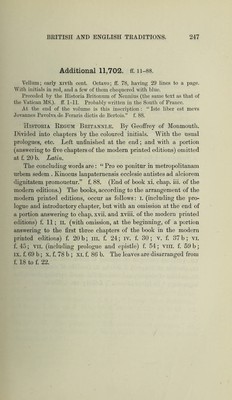
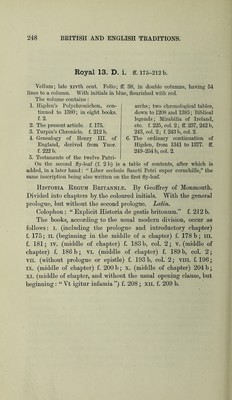
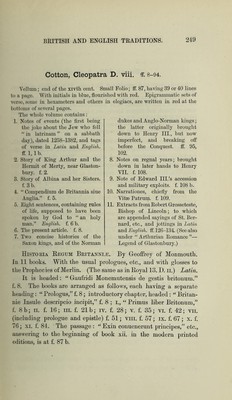
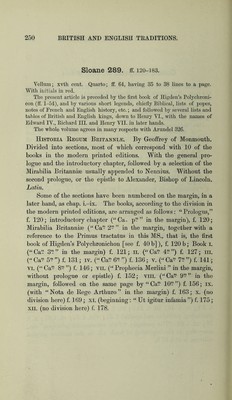
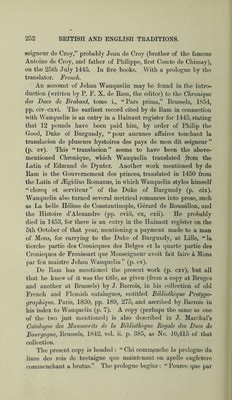
![Lansdowne 214. if. 85-193. Paper; about a.d. 1460. Folio The whole volume contains: 1. Legendary history of Belgium, compiled from Lucius Tongrensis and others, down to the time of Julius Caesar; in three books; beginning (like the ordinary French version of Guido delle Colonne): “ Ou temps que lao- medon roy de troyes.” f. 2. 2. The beginning of Caesar, De Bello Gallico; modernised. In- tended to form the fourth book of the compilation described above, in Latin. Beginning: “ Gallia ... ex tribus compone- batur nacionibus”; but imper- fect after the third line of what is here cap. xv. (but in Caesar, lib. i. cap. xxxiv.): “ Quahter cesar misit legates ad ariouistum ff. 109, having 36 to 40 lines to a page. 5. regem saxonum.” f. 80. The present article, f. 85. “ Les merueilles de lille de bre- taigne ”; translated (with slight additions) from the appendix to the Historia Britonum of Nennius, f. 194. “ Sept Articles de la Foi ”; a poem by Jean de Meung; beginning; “ 0 glorieuse trinite,” with many stanzas omitted, f. 196. 6. “ Apparition de Jean de Meung ”; a poem by Honoure Bonet, Prieur de Salon (see Additional 22,768, f. 6), author of “L’arbre des batailles.” f. 201. 7. La declaracion et significacion des lunes et des natiuitez.” ff. 217-275. The volume has been made up of three pieces (ending respectively at £f. 84 b, 195, and 275), written at different times, possibly by the scribe who has made this entry: “Ce liure a este escript de ma main et est a moy Couxtois.” f. 79 b. But some portions were perhaps written by another, of the same name, who, at the end of the present article (f. 193), where it is mentioned that it was translated at the request of “ monseigneur de croy ” (jwobably Jean de Croy, Captain-General of Hainaut in 1434-1465), has added: “ et de Jacotin le Courtois son receueur general.” At the end of the volume is written: “ Ce liure traicte . des cronicques dengletcrre et. de pluiseurs autres . liures. petis. Lequel est a Monseigneur Charles de croy comte de chimay.” This is signed Charles ” by the Comte de Cliimay (a grandson of Jean de Croy), who in 1486 was created Prince de Cliimay. At the foot of f. 195 is written : “ Le liure de la grant bertaigne dengleterr[e] et de merlin lequel est a monseigneur char[les] de Croy Prince de chimay.” This alludes to the present article, and the “merueilles,’’ which together evidently formed a separate volume (ff. 85-195) at that time. Finally, at the beginning (f. 2), is written: “Au due d’Arschot.” This was probably Philippe de Croy, who married the elder daughter and heiress of Charles, Prince de Chimay, was created Due d’Arschot in 1516, and died in 1549. (See Notice des Archives de M. le due de Caraman, by Gacbard, 1845.) Kings of Britain, Translated from Geoffrey of Monmouth’s Historia, by .lelian Wauquelin of Mons, at the request of “Mon-](https://iiif.wellcomecollection.org/image/b29001079_0001_0275.jp2/full/800%2C/0/default.jpg)