Improved apparatus to facilitate breathing in dust-laden or vitiated atmospheres / [Emil Witzenmann].
- Witzenmann, Emil.
- Date:
- 1904
Licence: Public Domain Mark
Credit: Improved apparatus to facilitate breathing in dust-laden or vitiated atmospheres / [Emil Witzenmann]. Source: Wellcome Collection.
1/4
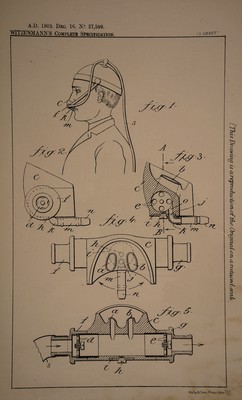
![N“ 27,599 A.D. 1903 Date of Application, 16th Dec-, 1903—Accepted, 21st Jan., 1904 COMPLETE SPECIFICATION. “ Improved Apparatus to Facilitate Breathing in Dust-laden or Vitiated Atmospheres I, Emil Witzenmann, Manufacturer, a subject of the Orand Duke of Hesse, residing* at Pforzheim, Holzgartenstrasse 48, m the Orand Ducky of Hesse, Germany, do hereby declare the nature of this invention and in what manner the same is to be performed, to be particularly described and ascertained in and by the 5 following statement: The present invention relates to a breathing* apparatus to be connected with a fresh air supply for use in places or apartments tilled with dust, smoke or gases and in which flap valves are employed to admit the fresh air and to carry oif the vitiated air. 10 The essential feature of the invention consists in providing a casing contain¬ ing: the flap valves with nozzles to communicate with the nose and with the mouth and also with a device for attaching the casing to the head of the person. By this means the person using the apparatus can breathe either through both nose and mouth or, if he be labouring under some nasal complaint, through his 15 mouth only, or he may breathe through his nose only, his mouth being* un¬ covered, so that he may speak for the purpose of giving1 directions or instructions. The improved apparatus is illustrated in the accompanying drawing, in which, Fig: 1 shews the manner in which the apparatus is used, 20 Fig): 2 is a side view thereof, Fig,: 3 is a cross section. Fig: 4 is a top plan view, and Fig: 5 is a longitudinal section on the line A—B of Fig: 3. The casing c is provided with nozzles or slits a and b, which the person, using 25 the apparatus, applies to his nostrils. At either end of the casing c is a flap valve d and e, one of which, d, opens inwards to permit of the entrance of fresh air, and the other, e, opens outwards, allowing the vitiated air to escape. The valves d and e may, as shewn in the drawing, be placed in caps provided with nozzles f and g, which caps are screwed onto the ends of the casing c, the nozzle/ 30 being adapted to receive the tube s for the supply of fresh air or oxygen, such tube being preferably a spiral metal one. At a point in the lower part of the casing c between the two flap valves d and e is placed a device for connecting the casing with the mouth of the wearer and which can be opened and closed at pleasure. In the construction shewn, this 35 device consists of a disc i, turning on the pin h and provided with an open¬ ing j, which communicates with a nozzle k, joined to a tube m and mouth¬ piece n. This nozzle k may, where the person using the apparatus wishes to breathe through both mouth and nose, be brought into communication with a passage o in the casing by rotating the disc i; or, if the person wishes to 40 breathe through his nose, or in case he wishes to give occasional orders or in: structions, and consequently has to remove the mouthpiece from his mouth, the nozzle may be brought under the solid portion of the casing c by turning the disc in the other direction, so that the passage o in the wall of the casing is cut oif and the i** * nous gases thereby prevented from entering the breathing casing bv the mouthpiece when the latter is not in use. [Prmt 8d.]](https://iiif.wellcomecollection.org/image/b30738805_0001.jp2/full/800%2C/0/default.jpg)